
Imagine spending your entire Saturday framing a new Trex deck in your Lexington backyard, only to realize the final corner is three inches off from being square. That sinking feeling is common for many DIYers who worry that a small measurement error will lead to a lopsided structure or a costly professional fix. Learning how to do alignment at home is the secret to building a legacy that lasts, ensuring your project is both beautiful and structurally sound from the very first measurement.
You want your home to be a sanctuary, but a wobbly pergola or an out-of-square addition can quickly turn a weekend project into a stressful headache. It doesn’t require a degree in advanced geometry to get professional results, but it does require the right techniques to ensure every post and beam is perfectly level. We’ve spent over 20 years helping Central Kentucky homeowners bring their visions to life with precision and care. In this guide, we’ll share the professional secrets to keeping your project square. You’ll learn the essential steps for accurate layout, the famous “3-4-5 rule,” and how to recognize when a complex framing job needs the expertise of a master craftsman to ensure your home remains safe and beautiful.
Key Takeaways
- Understand why precision at the foundation is non-negotiable to prevent small errors from becoming major structural gaps at the roofline.
- Master the 3-4-5 rule to learn how to do alignment at home, ensuring every corner of your new deck or pergola is perfectly square.
- Discover how to use batter boards and fixed benchmarks to maintain a consistent, unmoving reference point throughout your build.
- Learn how Central Kentucky’s clay soil affects long-term settling and why professional-grade laser levels are vital for seamless home additions.
- Recognize the clear signs that a project requires professional oversight to ensure structural durability and compliance with Lexington building codes.
The Importance of Structural Alignment: Why Precision Matters for Your Home
Structural alignment is the process of ensuring every wall, post, and foundation is perfectly square, level, and plumb. When you start learning how to do alignment at home, you’re doing more than just measuring; you’re building a legacy. A home that is “true” provides a sense of sanctuary. It means your doors swing exactly how they should and your floors remain solid and silent underfoot. Precision is especially critical when installing Trex or lumber decking. If your frame is even slightly off, your decking boards won’t lay flat, which can cause pooling water or tripping hazards.
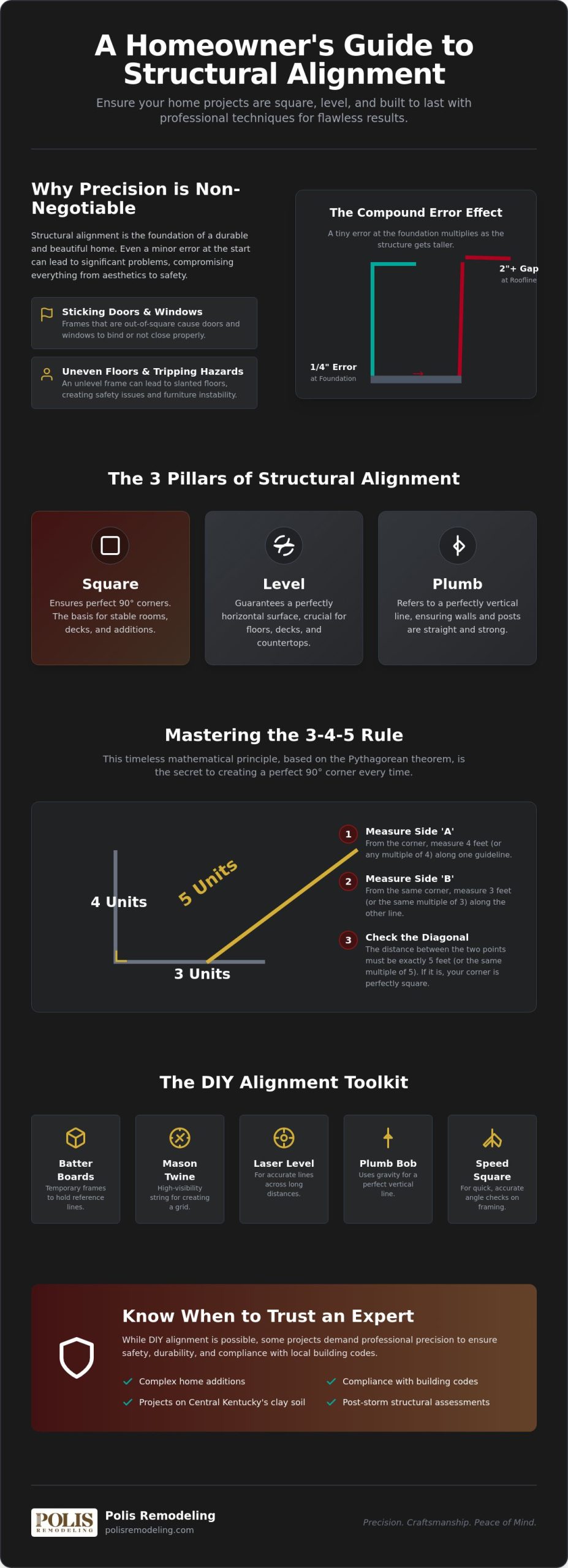
Even a tiny 1/4-inch mistake at the foundation can expand into a 2-inch gap by the time you reach the roofline. This compound error is often what separates a DIY headache from a professional masterpiece. To see how these principles apply to mechanical and structural tasks, watch this helpful video:
Signs of Poor Alignment in Existing Structures
In many older Central Kentucky homes, alignment issues show up as sticking doors or windows that refuse to stay open. You might notice a slight slant in the kitchen or gaps in the baseboards. Sometimes, these issues aren’t just from age. Significant storm damage can shift a home’s structure, making a professional assessment vital to ensure your foundation is still sound.
Square vs. Level vs. Plumb: Knowing the Difference
Understanding these three terms is the first step in mastering construction. Square refers to creating perfect 90-degree angles, often achieved by using the mathematical principles of a Pythagorean triple. Level ensures horizontal accuracy across a room or deck surface. Finally, Plumb means your vertical supports, like wall studs and posts, are perfectly upright. Learning how to do alignment at home starts with knowing these three definitions. If any of these are missing, the structural integrity of your project is at risk.
Step-by-Step: How to Do Structural Alignment at Home Using the 3-4-5 Rule
Getting your layout right is the most satisfying part of any build. It’s the moment your vision starts to take a physical shape. To begin, clear your site completely and establish a benchmark. This is a fixed, unmoving starting point, like a corner of your house or a specific spot on the foundation. Everything else you measure will relate back to this one point, so it has to be perfect.
Next, set up batter boards. These are simple, temporary frames made of scrap lumber placed just outside your actual work area. By stretching high-visibility mason twine between these boards, you create a grid that represents your future walls or deck perimeter. This keeps your lines out of the way of digging and post-setting while giving you a constant reference. Learning how to do alignment at home involves mastering the 3-4-5 method for squaring corners. Measure 3 feet along one string and 4 feet along the intersecting string. If the diagonal between those two marks is exactly 5 feet, your corner is a perfect 90 degrees. If the math feels a bit daunting, consulting with a remodeling professional can ensure your foundation is set correctly from day one.
Essential Tools for DIY Alignment
While a traditional spirit level works for small tasks, a laser level is a game changer for outdoor projects in Lexington. It allows you to shoot a level line across 20 or 30 feet with incredible accuracy. You should also keep a high-quality plumb bob in your kit. This simple weighted string uses gravity to give you a perfect vertical line every time. For quick framing checks, a speed square is indispensable for ensuring your smaller joints stay tight and true.
Aligning a New Deck to an Existing Home
When you’re adding a new Trex deck, alignment starts at the house. Your ledger board must be perfectly parallel to the existing foundation to prevent the deck from looking “crooked” against the siding. Aligning your outer posts requires double-checking your string lines against the house wall. This ensures the finished structure looks like a natural, seamless extension of your home rather than an afterthought.
Professional Alignment: Ensuring Your Lexington Home Addition Lasts a Lifetime
Precision is the heartbeat of a successful home addition. While you can learn how to do alignment at home for a garden gate or a small shed, custom home additions demand a higher level of technical accuracy. We use professional-grade transit levels and advanced laser equipment to ensure your new space is perfectly synchronized with your existing structure. This isn’t just about aesthetics; it’s about the long-term structural integrity of your sanctuary.
Central Kentucky presents unique challenges, specifically our heavy clay soils. This soil type is notorious for expanding and contracting, which can lead to significant “settling” over time. If your initial alignment is off by even a fraction, this natural movement can cause cracked drywall or leaking windows years down the road. To address these exterior vulnerabilities, Powersol Solutions offers expert window and roofing services that help maintain a weather-tight seal despite structural shifts. Professional alignment accounts for these local conditions, ensuring your foundation footings are deep enough to provide a stable legacy for your family. Integrating new framing with an existing roofline is another area where DIY efforts often struggle. A master craftsman understands how to marry these two structures so they look and function as one, preventing the “tacked-on” look that hurts property value.
Navigating Local Lexington Building Codes
Building inspectors in Fayette County are meticulous for a reason. They check for squareness and proper footing depth to ensure every project meets the 2018 Kentucky Residential Code. This oversight is especially vital for aging-in-place renovations. In these projects, perfect floor transitions are a matter of safety rather than just style. Even a tiny lip between a hallway and a new bathroom can become a tripping hazard, so we prioritize flush, level surfaces in every layout.
When to Call Polis Remodeling for Your Project
We believe in turning your vision into a reality without the stress of “out-of-square” surprises. Our master craftsman approach is what defines our kitchen and bathroom remodels, where every cabinet and tile must be perfectly aligned to look its best. While the 3-4-5 method for squaring corners is a great starting point for many homeowners, complex structural work often requires a steady, experienced partner. If your project involves moving load-bearing walls or tying into a complicated roofline, professional oversight protects your investment and your peace of mind.
Building a Legacy of Precision in Your Home
Mastering the layout of your project is the first step toward creating a space you’ll love for decades. Whether you’re using the 3-4-5 rule for a new pergola or setting up batter boards for a custom deck, the time you spend on precision pays off in long-term structural stability. Knowing how to do alignment at home gives you the confidence to tackle basic framing; however, remember that Central Kentucky’s unique clay soil and strict building codes require a careful, experienced eye. Small errors at the start can lead to major headaches later, especially when tying new additions into an existing structure.
For homeowners interested in how these structural standards are applied to sustainable living spaces, Sicewood Pty Ltd provides a great example of combining precision with eco-friendly building practices.
As a locally owned and operated business in Lexington, we bring over 20 years of expertise to every project. We specialize in structural integrity and high-end outdoor living, viewing every renovation as a personal mission to enhance your daily life. Our master craftsman approach ensures that your home remains a sanctuary, built with the meticulousness it deserves.
Contact Polis Remodeling for a professional consultation or estimate today.
Your dream project deserves a perfect start. We’re here to help you bridge the gap between vision and reality, ensuring your home remains beautiful and structurally sound for generations to come.
Frequently Asked Questions
How do I know if my deck is perfectly square?
The most reliable way to check for squareness is to measure the diagonals of your frame. Start at one corner and measure to the opposite diagonal corner, then repeat the process for the other two corners. If those two numbers are exactly the same, your deck is perfectly square. This diagonal check is the final step after using string lines to ensure nothing shifted while you were setting your posts.
Can I use a standard tape measure for the 3-4-5 rule?
Yes, a standard 25-foot tape measure is all you need to learn how to do alignment at home using this method. The key is to ensure the tape is pulled tight and stays perfectly flat against your layout strings. For larger projects like a detached metal building or a large sunroom, you might find a 100-foot fiberglass tape easier to handle to prevent sagging over long distances.
What happens if my home addition is not aligned with the original house?
An unaligned addition creates a ripple effect of structural problems that get worse as the build progresses. You’ll likely struggle with roof trusses that don’t sit flat or siding that looks crooked against the old house. Beyond the visual headache, it can lead to chronic water leaks at the transition points. This is why we prioritize professional-grade laser alignment for every addition we build in Central Kentucky.
Do I need a laser level for a DIY home project?
You don’t strictly need a laser level for small projects like a garden gate, but they are highly recommended for decks and additions. A standard spirit level is difficult to use accurately over distances longer than eight feet. A laser level allows you to establish a consistent “level” height for every post in your backyard at once, which is vital for a flat, safe walking surface.
How does Central Kentucky soil affect the alignment of my deck posts?
Lexington is known for heavy clay soil that expands and contracts significantly with the seasons. If your deck footings aren’t dug deep enough, this soil movement can cause “frost heave,” which literally pushes your posts upward and out of alignment. We always ensure footings are deep enough to bypass this movement, protecting the structural integrity of your outdoor living space for years to come.
Is it possible to fix a wall that is out of plumb after it is built?
Fixing a wall that is leaning or “out of plumb” is very difficult once the framing is nailed together and the drywall is installed. It often requires removing the wall finish and using heavy-duty jacks or braces to force the studs back into a vertical position. It’s much more cost-effective to check your alignment multiple times during the framing stage than to attempt a repair later.
Precision is the difference between a project that causes stress and one that adds lasting value to your life. If you’re ready to ensure your next home improvement project is built with master-level accuracy, contact Polis Remodeling for a consultation or estimate today. Our team brings over 20 years of local experience to every job, ensuring your home remains a stable and beautiful sanctuary.

Article by
Elizabeth Richardson
Elizabeth Richardson has more than 20 years of experience in residential remodeling, construction management, and small business ownership. As the co-owner of Polis Remodeling, she has helped homeowners throughout Central Kentucky transform kitchens, bathrooms, basements, additions, and whole-home renovations with a focus on quality craftsmanship, clear communication, and lasting value.
In addition to her construction background, Elizabeth is also a licensed Kentucky Realtor, giving her a unique perspective on the improvements that add value, enhance marketability, and help homeowners make informed decisions before buying, selling, or remodeling a home. Through her articles, she shares practical advice, remodeling insights, and real estate knowledge to help homeowners confidently invest in their properties.
Disclaimer
This article is for general informational purposes only and should not be considered professional construction, remodeling, or legal advice. Every home and project is unique. Contact Polis Remodeling for recommendations specific to your home and remodeling goals.