
Could a single degree of error in your new home addition lead to thousands of dollars in structural cracks just a few years down the road? It’s a question that keeps many Lexington homeowners awake at night, especially when you’re investing your hard-earned savings into a sanctuary for your family. You deserve to know that your project is built on a foundation of precise, accurate angles, where every joint and beam is perfectly aligned to ensure your home remains stable for a lifetime.
We at Polis Remodeling understand the anxiety that comes with hiring a contractor; nobody wants to worry about someone cutting corners on the parts of the house you can’t see. You want a space that feels solid and remains beautiful for decades, not just until the check clears. This guide will show you exactly why geometric precision is the non-negotiable standard for any high-quality deck, sunroom, or kitchen expansion. We’ll strip away the confusing technical jargon and explain the “square, level, and plumb” benchmarks that separate master craftsmanship from a rushed job, giving you the confidence to choose a partner who values your peace of mind as much as the finished product.
Key Takeaways
- Learn why the “Square, Level, and Plumb” triad is the essential gold standard for preventing unsightly wall cracks and future structural settling.
- Understand how right angle construction allows your home to distribute weight evenly across load-bearing walls, ensuring a lifetime of stability for your addition.
- Discover how master builders combine time-tested geometric rules with modern laser technology to eliminate guesswork and ensure your new space is perfectly aligned.
- Gain insight into how Central Kentucky’s specific building codes and clay-heavy soil require reinforced framing and meticulous precision to pass inspection and protect your investment.
The Foundation of Quality: Why Right Angle Construction Standards Matter
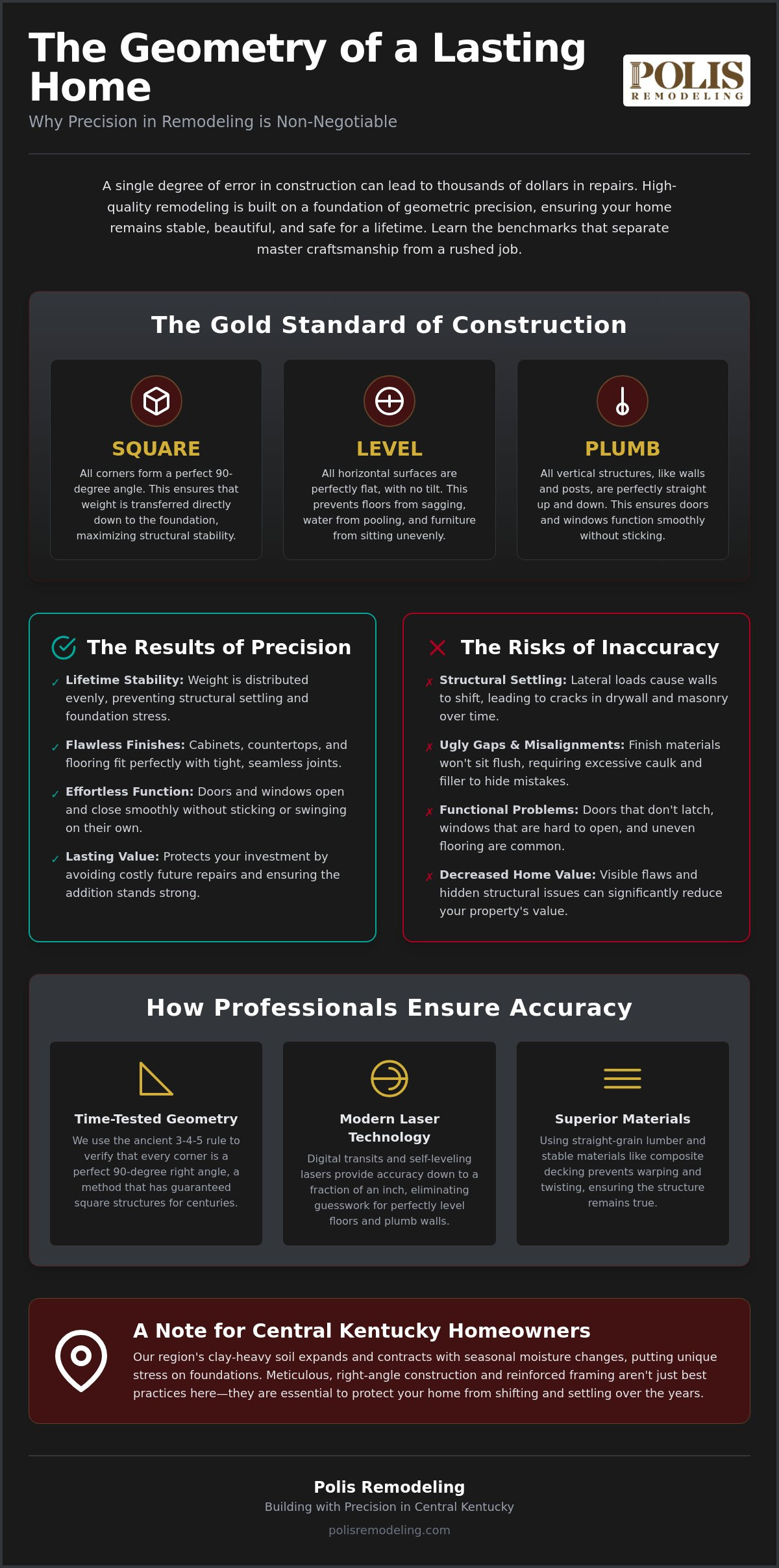
In the world of residential building, we live by a sacred triad: square, level, and plumb. These aren’t just industry buzzwords. They represent the difference between a home that stands the test of time and one that begins to fail within a decade. Square means corners are exactly 90 degrees. Level means horizontal surfaces are perfectly flat. Plumb means vertical walls stand straight up and down. The Foundation of Quality begins with these measurements. Specifically, right angle construction is the practice of ensuring every structural intersection meets at exactly 90 degrees for maximum stability.
When your home’s framing is perfectly square, the weight of the roof and upper floors travels straight down into the foundation. If a wall is even slightly tilted, that weight pushes sideways instead. Over time, this lateral load causes structural settling. You’ll eventually see those frustrating cracks in your drywall or doors that suddenly won’t latch. Precision framing ensures that gravity works for your home, not against it.
This commitment to structural health is shared by top-tier contractors like United Roofing & More!, who emphasize precision and professional standards in their roofing guides to help homeowners protect their properties.
Poor framing also creates a ripple effect that ruins the finishing stages of a project. If your walls aren’t square, your beautiful new kitchen cabinets won’t sit flush against the wall. You’ll see ugly gaps behind the backsplash and crooked lines in your hardwood flooring. It’s much easier to build it right the first time than to try and hide mistakes with trim and caulk later. Precision at the start prevents these expensive headaches at the end.
The Geometry of Longevity in Home Additions
Adding a new room is a complex task because you’re marrying a new structure to an existing one. Home additions require perfect alignment to ensure the rooflines match and the floors stay level between the two spaces. In Central Kentucky, our seasonal shifts and clay-heavy soil put immense pressure on foundations. Using right angle construction during the framing phase protects your investment by giving the addition the structural integrity it needs to resist shifting during our humid summers and freezing winters.
Visual Signs of Precision Craftsmanship
You don’t need an engineering degree to spot a job well done. Look closely at the corners where your crown molding or baseboards meet. In a square room, those joints are tight and seamless. If you see thick lines of caulk or visible gaps, the walls likely aren’t square. Perfectly plumb walls also ensure that your windows and doors operate smoothly. If a door swings open on its own or sticks in the frame, it’s often because the wall isn’t vertical. Precision framing makes the daily experience of your home feel effortless and solid.
How Professional Remodelers Achieve Structural Precision
Building a square foundation is an ancient art. Master builders still rely on the 3-4-5 rule, a simple geometric formula where measuring three feet on one side and four feet on the other must result in a five-foot diagonal. If those numbers don’t match, the corner isn’t square. While this method is timeless, we now pair it with digital transits and laser levels to achieve a level of accuracy that was impossible just a few decades ago. Using these tools ensures that right angle construction is a reality from the very first shovel in the ground.
High quality materials play a silent but vital role in this process. We prefer straight-grain lumber because it’s less likely to warp or “crown” as it dries. Similarly, using Trex decking provides a stable, consistent surface that won’t twist like lower-grade pressure-treated wood often does. Why does this matter? Because even the most skilled carpenter can’t build a straight wall with crooked boards. This commitment to Construction Standards Matter most during the hidden stages of your project, such as when we are setting floor joists or laying out roof rafters. If these internal skeletons are off by even half an inch, it creates a nightmare for the finish crew later.
Precision in Outdoor Living Structures
Outdoor projects face the harshest conditions in Central Kentucky. A deck frame must be perfectly square so that your composite boards lay flat with uniform gaps. If the framing is “racked” or out of square, the gaps between boards will grow or shrink across the surface, ruining the look. Precise post-setting is equally critical. It prevents pergolas and sunrooms from leaning over time as the ground settles. If you’re planning an outdoor upgrade, you can discuss your vision with a local expert to ensure the structural bones are built to last.
Kitchen and Bath: Where Fractions of an Inch Count
Inside the home, kitchen remodeling is the ultimate test of right angle construction. Modern stone countertops, like granite or quartz, are completely unforgiving. They are cut by machines to exact dimensions. If your walls aren’t perfectly square, you’ll end up with massive gaps at the ends of your counters that even a backsplash can’t hide. In bathrooms, square walls are the only way to ensure tile patterns stay straight and glass shower doors close with a watertight seal.
Choosing a Partner for Precise Construction in Central Kentucky
Local builders know that Central Kentucky’s landscape presents unique challenges. Our region’s clay-heavy soil is notorious for expanding and contracting with the seasons. This movement puts constant stress on your home’s foundation. Without a commitment to right angle construction, a simple home addition can quickly develop structural issues. Professionals must use reinforced framing techniques to ensure the building remains stable despite the ground beneath it.
In cities like Lexington and Georgetown, building inspectors don’t accept “close enough.” They follow the 2018 Kentucky Residential Code strictly. A project that is out of square or lacks proper load distribution will fail inspection, leading to costly delays. You need a partner who views these codes as the minimum baseline, not a hurdle to clear. This is especially true for storm damage restoration. When high winds or fallen trees rack a home’s frame, it takes a master’s eye to bring the structure back to a perfectly square state before cosmetic repairs begin.
Questions to Ask Your Contractor About Framing Quality
Dig into the details of a contractor’s process before signing a contract. Ask how they verify squareness at every stage of the build. Do they use digital transits or just a standard tape measure? If you are planning a bathroom remodel in an older Lexington home, ask how they handle existing walls that are already out of plumb. A true professional will have a plan to shim or “sister” studs to create a perfect surface for your new tile or glass shower enclosure.
The Polis Remodeling Standard of Excellence
We’ve spent over 20 years proving that a true sanctuary is built on a foundation of trust and precision. We treat every project as a personal mission to improve your daily life. Meticulous detail isn’t just about aesthetics; it’s about the legacy of your home. While it’s tempting to choose the lowest bid, prioritizing structural integrity ensures your investment lasts for decades. Your home deserves a visionary guide who can translate complex blueprints into a perfectly executed physical space.
Building Your Legacy on a Solid Foundation
Your home is your legacy. It’s the sanctuary where your family’s story unfolds every day. We’ve explored how the meticulous practice of right angle construction serves as the invisible backbone for every durable kitchen, bath, and home addition. By insisting on square and plumb standards during the framing stage, you’re protecting your investment from the structural settling and unsightly cracks that often haunt lower quality builds.
For example, resources from Arkansas Home Improvement allow you to explore Roofing Installation and other remodeling costs to help you plan your next home improvement project.
As a locally owned and operated business by the Polis family, we bring 20+ years of Central Kentucky experience to every job site. We’ve spent decades as specialists in Trex & Lumber Decking, helping our neighbors create outdoor spaces that remain beautiful and safe for a lifetime. We believe that professional authority should always be paired with a warm, neighborly approach. You deserve a partner who values your peace of mind as much as the final physical outcome.
Ready to build your dream space with precision? Contact Polis Remodeling for an estimate today. We’re ready to help you turn your next home improvement vision into a solid reality.
Frequently Asked Questions
What does ‘square’ mean in home construction?
In home building, “square” describes two structural members that meet at a perfect 90-degree angle. This is the goal of every professional project, from a small bathroom remodel to a large kitchen expansion. When a corner is square, it ensures that finishing materials like tile, cabinetry, and flooring fit together without awkward gaps. It’s a primary indicator of structural precision in any residential project.
How do I know if my contractor is building my addition correctly?
You can monitor the framing stage by looking for the tools and methods your crew uses. Professional builders will frequently use laser levels, digital transits, and large framing squares to verify their work. If you see them performing diagonal measurements on your foundation or floor joists, it’s a sign they prioritize right angle construction. Don’t be afraid to ask your project manager how they ensure the new addition aligns perfectly with your existing home.
Will an ‘out of square’ wall affect my home’s resale value?
Visible signs of poor framing can definitely impact your home’s resale value during a home inspection. Inspectors in Central Kentucky look for “racked” door frames, sloping floors, or significant drywall cracks that suggest structural settling. These issues often stem from walls that weren’t built square or plumb. While a slightly crooked wall might seem minor, it often signals to potential buyers that other hidden parts of the home might have been built with less care.
Can you fix a wall that wasn’t built at a right angle?
We can often correct out-of-square walls, but the solution depends on the stage of the project. If the issue is discovered during a bathroom remodel, we can “sister” new studs to the existing ones to create a perfectly flat and square surface for tiling. If the problem is structural, it may require more intensive work to re-align the framing. It’s always best to consult a master craftsman to determine the safest and most cost-effective way to restore your home’s integrity.

Article by
Elizabeth Richardson
Elizabeth Richardson has more than 20 years of experience in residential remodeling, construction management, and small business ownership. As the co-owner of Polis Remodeling, she has helped homeowners throughout Central Kentucky transform kitchens, bathrooms, basements, additions, and whole-home renovations with a focus on quality craftsmanship, clear communication, and lasting value.
In addition to her construction background, Elizabeth is also a licensed Kentucky Realtor, giving her a unique perspective on the improvements that add value, enhance marketability, and help homeowners make informed decisions before buying, selling, or remodeling a home. Through her articles, she shares practical advice, remodeling insights, and real estate knowledge to help homeowners confidently invest in their properties.
Disclaimer
This article is for general informational purposes only and should not be considered professional construction, remodeling, or legal advice. Every home and project is unique. Contact Polis Remodeling for recommendations specific to your home and remodeling goals.